Crack the clues. Discover the next stop. Read your way across America.
A 250-stop coded expedition. Crack each waypoint's three clues to name the next destination — part Oregon Trail, part treasure hunt. Wrong answers cost days; quick checks earn provisions; a flawless run earns a shortcut.
Acadia National Park
Maine · Leg 1 — New England
Read a place. Crack its code. Earn the next stop.
Every stop follows the same path — easy for teachers to run and easy for students to follow.
Explorer, Navigator, or Scholar. Reading and clues adjust to fit.
Read the passage, pass quick checks to earn provisions, and stamp your passport.
Each clue gives one fragment. Combine them to name the next waypoint — a flawless run unlocks a shortcut.
Birth of America & Great Minds
The journey begins at Acadia. The next waypoint stays encrypted — students reveal it only by securing all three clues.
Setbacks on the trail are real Acadia conditions. Curious why they happen? Open any card to learn the science behind it.
🌫 Fog off Frenchman Bay
🌊 High tide on the carriage road
🪮 Black flies in the spruce
⛈ A squall on Cadillac Mountain
🪨 Loose granite on the Beehive
🌀 A nor'easter off the Atlantic
Acadia Explorer Stamp
Tap each bullet to check it off — Vocabulary & Secure the Clues check themselves as you finish them.
Official sources
See the place before you read it.
Take a short flyover of Acadia's coast, forests, and granite peaks — then choose your level and begin. Teacher presses play; nothing autoplays.
Scenic Acadia footage via YouTube (privacy-enhanced embed). Prefer the official park film? Swap in “Acadia Always” from the National Park Service at nps.gov/acad. Always preview before class.
Pick your expedition band to begin.
Your reading passage, activities, vocabulary, quick checks, and clue difficulty all adjust to the level you choose. Tap a card — your materials appear below.
Pick Explorer, Navigator, or Scholar to load the reading passage, vocabulary, questions, and book list for that band.
The First Light of Morning
Far up the coast of Maine sits Acadia National Park, a place of forests, mountains, rocky shores, and bright ocean views. Many people visit Acadia each year to hike, bike, watch animals, and enjoy fresh air.
One famous place is Cadillac Mountain. During part of the year, it is one of the first places in the United States to see the sunrise. The sky turns orange and pink, and the ocean shines below.
Acadia is home to many living things. Deer walk in the forest, seals swim near the shore, and eagles soar above the trees. Each one needs a habitat with food, water, shelter, and space.
People work hard to protect Acadia. Rangers care for the trails and families stay on the paths. These small choices keep the park healthy for everyone who visits next.
- Read the whole line once to hear it.
- Find small groups of words that belong together.
- Sweep a curved “scoop” under each group with your finger or pencil.
- Read each scoop in one breath — smooth, like talking, not word-by-word.
- The slashes ( / ) show where each new scoop begins.
- Read each chunk, then blend the chunks together fast.
Talk about the text
- Where is Acadia National Park?
- What is Cadillac Mountain famous for?
- Name two animals that live in or near Acadia.
- Tell one way people protect the park.
Explorer words
For Explorers
Why should we protect nature?
What makes a national park special?
How do animals depend on their habitats?
Stock up for the trail
Answer correctly to add provisions for the journey ahead. Clue setbacks cost provisions — these checks and your research earn them back.
Anchor books for Explorers
Read-aloud and early-reader titles that pair with Acadia’s habitats and the New England story.
A Park Worth Protecting
Long before Acadia National Park existed, glaciers shaped the land along Maine’s rugged coast. Huge sheets of ice carved valleys, smoothed mountains, and left behind lakes, ponds, and rocky shorelines that visitors can still read today.
In the late 1800s and early 1900s, many Americans worried that beautiful natural areas were disappearing. Citizens, conservation groups, and generous landowners decided to act. They donated land and worked with public leaders to protect the area that became Acadia.
Established in 1919, the park now shelters forests, mountains, lakes, wetlands, islands, and rocky coast. These ecosystems support white-tailed deer, bald eagles, peregrine falcons, porcupines, and harbor seals — an outdoor classroom for weather, erosion, tides, biodiversity, and human impact.
Rising 1,530 feet, Cadillac Mountain offers wide views of Frenchman Bay and, in certain months, one of the first US sunrises. Acadia teaches a civic lesson: public lands belong to everyone, but everyone must help care for them.
- Read each phrase between the slashes as one smooth chunk.
- Read it twice, then focus on meaning.
Check for understanding
- How did glaciers shape the land that became Acadia?
- Why did citizens and conservation groups want to protect this region?
- What habitats and species are mentioned in the passage?
- How does Cadillac Mountain connect geography and science?
- What civic lesson does Acadia teach? Use evidence from the text.
Navigator words
For Navigators
How can people enjoy nature while protecting it?
Why did Americans create national parks?
How do ecosystems stay balanced?
Stock up for the trail
Answer correctly to add provisions for the journey ahead. Clue setbacks cost provisions — these checks and your research earn them back.
Anchor books for Navigators
Middle-grade titles that deepen the leg’s history, identity, and civic themes.
Conservation and the American Landscape
Acadia National Park represents a powerful chapter in the American conservation story. Its rocky headlands and ocean views often appear timeless, but the landscape is the result of both natural forces and human choices — a connected system of terrain, water, climate, organisms, and human access.
The human history is equally important. The Wabanaki have deep and continuing connections to the land now known as Maine. Later, settlers, artists, scientists, and conservationists shaped the region’s story. In the early twentieth century, fears that development would change the coast forever moved citizens, philanthropists, and government leaders to preserve land for public use.
Unlike some western parks created mainly from federal land, Acadia grew through a remarkable pattern of private donations, local action, and public stewardship. That history makes it a strong example of civic responsibility — democracy as organized action, public debate, shared resources, and long-term thinking.
Today Acadia is a living classroom for environmental science and public decision-making. Staff and visitors must balance recreation with preservation: too many visitors can damage fragile trails, yet public access is part of the park’s democratic purpose. It asks the lasting America 250 question — what should one generation protect for the next?
Read closely and analyze
- How does Acadia connect natural history and human history?
- Why is it important to include Wabanaki connections when teaching Acadia?
- How did citizen action contribute to the creation of the park?
- What tensions exist between public access and preservation?
- Evaluate the final America 250 question: what should one generation protect for the next?
Scholar words
For Scholars
What responsibilities do citizens have toward conservation?
How should society balance preservation and development?
What should one generation protect for the next?
Stock up for the trail
Answer correctly to add provisions for the journey ahead. Clue setbacks cost provisions — these checks and your research earn them back.
Anchor books for Scholars
Advanced titles connecting Acadia to conservation thinking, justice, and the American landscape.
Three clues hide the road ahead.
Each clue gives you one secret fragment. No single clue names the destination — only by securing all three and combining the fragments can you discover and unlock the next waypoint.
The field cipher, vocabulary match, and word scramble all adjust to the level you pick above.
Decode the first fragment of the next waypoint’s name.
Long the Wabanaki walked this shore,
Yonder bays where the eagles soar.
Tap a word, then tap its meaning. Match every pair to recover the fragment.
Unscramble every word using its clue to recover the fragment.
Decode the first fragment of the next waypoint’s name.
Tap a word, then tap its meaning. Match every pair to recover the fragment.
Unscramble every word using its clue to recover the fragment.
Decode the first fragment of the next waypoint’s name.
Tap a word, then tap its meaning. Match every pair to recover the fragment.
Unscramble every word using its clue to recover the fragment.
Finish Stop 1 with a flawless run (no setbacks) OR earn the full Acadia Explorer Stamp, and you can skip the next waypoint to save days on the trail.
Dig into the Acadia word challenge.
Two NYT-style puzzles built from this stop's vocabulary — Strata Sort and Core Sample. Solve one to earn a provision for the trail.
“The nation’s story is not only found in battlefields, buildings, and documents. It is also found in mountains, forests, coastlines, and public places protected for the next generation.”
As the first stop, Acadia asks a question that follows students across all 250 stops: What parts of America are we responsible for protecting?
Layers of knowledge. Rock-solid skills. A reader, lit.
Leg 1 · Stop 1 — Acadia National Park · Teacher Guide
Aligned to NYS Next Generation ELA, C3 Social Studies & NGSS-style practices.
Key facts checked against National Park Service materials. Preview external sites before student use. nps.gov/acad · Wabanaki Nations
Two halves. One word. Say it first.
Number Battles hid numbers behind clues and made kids multiply. Word Battles breaks words into their working parts and makes readers blend — the exact move that turns a decoded word into a word they simply know. Fast, loud, and built on a real scope and sequence.
Words come apart. Your brain puts them back together.
Multiplication combines two factors into a product. Blending combines two word parts into a word. Same move, different subject — which is why the Number Battles engine ports over almost untouched.
Read the parts
Each card holds a working piece of English — a letter team, a syllable, or a meaning chunk. See str. Say /str/. The keyword underneath is the anchor when the sound won't come.
Blend them
Two cards flip. Push the parts together into one whole word: str + ike. Blending under mild pressure is what bonds spelling to pronunciation — the mechanism that makes words instantly recognizable later.
Take the pile
Say it first — or, on screen, tap it out of four near-identical words. Win rounds, win cards, climb the ranks. At Ranger, wild suffix cards enter and the spelling rules start to bite.
Why four near-identical choices? The distractors differ from the answer by a single sound — strike / strip / stick / streak. A reader who guesses from the first letter gets it wrong. The only way through is to read every grapheme, which is the whole point.
Take the field. Earn your rank.
Pick a level, then start at Recruit and climb to Trailblazer. The clock stays off until your accuracy earns it — speed is a reward here, never the entry fee.
Recruit · untimed. Clear 5 blends at 80% accuracy to unlock the clock.
Press Start the battle to deploy.
Table Mode. The printed deck runs the same round out loud: flip two cards, blend, and the first correct spoken word takes the pile. The screen game builds the daily reps; the deck turns them into face-to-face play. Two halves of one system — the same structure Number Battles runs on.
Word automaticity is necessary. It isn't sufficient.
Most word-game products stop at the card and call it fluency. The evidence points somewhere else: the strongest fluency lever is repeated and assisted reading of connected text. So every Word Battles deck ships in three tiers, and the passage tier is the one that earns the name.
The battle deck
Blend two parts into a whole word, fast. Builds accurate, automatic word recognition and bonds spellings to pronunciations, pattern by pattern.
Phrase-cued cards
The same words inside short phrases, marked at natural breaks and read in one breath. Trains chunking and phrasing — the bridge between reading words and reading sentences.
Controlled passages
Short passages built only from patterns already taught. Partner reading, three passes, with an expression rubric on the back. This is where rate, accuracy, and prosody come together.
The deck order is the scope and sequence.
This is the single most important design decision in the product. Later decks may reuse everything taught earlier; earlier decks may never borrow forward. Cumulative, systematic, and defensible to any reading specialist who asks.
CVC Clash
Short vowels, single consonants. The foundation deck — every reader starts here regardless of age.
Digraph Duel
Two letters, one sound: sh, ch, th, wh, ck, ng.
Blend Brawl
Beginning and ending clusters — str, spl, nd, mp. The deck where most struggling readers stall out.
Silent-E Standoff
The vowel-consonant-e pattern and the words it flips: cap/cape, hop/hope.
Vowel Team Volley
ai, ea, oa, ee, igh, oo — plus the honest fact that some teams say two things.
R-Controlled Rumble
ar, or, er, ir, ur. The vowels that stop behaving when r shows up.
The Six Types
One deck per syllable type — closed, open, silent-e, vowel team, r-controlled, consonant-le. Where single-syllable readers become multisyllabic ones.
Prefix Pursuit · Suffix Strike
Meaning chunks that unlock thousands of words at once: re-, pre-, un-, -tion, -ment, -ous.
Roots & Combining Forms
Latin roots and Greek combining forms — port, dict, spect, geo, tele, graph, scope.
High-Frequency Words
The regular parts decoded, the irregular part flagged and learned by heart. No whole-word memorizing of words that follow rules.
Phrase & Expression
Tier 2 as a standalone deck: phrase-cued reading and expression duels, where a partner guesses the punctuation from your voice.
Expedition Decks
Place-based decks cut from expedition vocabulary — New England, Mid-Atlantic, and on down the route. The fluency layer of the reading expedition.
Explorer, Navigator, Scholar.
Same three levels as the reading expedition, and for the same reason: no grade labels anywhere, so a twelve-year-old on Explorer is playing the same game as everyone else. Each level shows a little less support and asks the reader to carry a little more.
Explorer
Full support- Picture, letter team, and keyword all shown
- Single-syllable words
- Distractors differ by an obvious sound
- Untimed by default
Navigator
Keyword only- Picture removed — keyword remains
- Two-syllable words, all six syllable types
- Distractors differ by one vowel or one blend
- Clock unlocks at Scout
Scholar
Meaning only- No keyword — the card shows the morpheme's meaning
- Latin roots and Greek combining forms
- Distractors are real words sharing a root
- Wild suffixes carry spelling rules
Recruit to Trailblazer.
Levels say what you're reading. Ranks say how far you've climbed inside a session — and each promotion changes the rules, so the game keeps getting harder without ever changing subject.
Recruit
No clock. Full support. Accuracy is the only thing being measured — and the only way out.
Scout
The 60-second clock starts. Correct answers add time; wrong ones take it. Streaks begin to pay.
Ranger
Wild suffix cards enter the deck. Blend the word, then spell the inflected form correctly — drop the e, double the consonant.
Trailblazer
Support strips one more notch and distractors tighten to a single grapheme. Nothing left but the reading.
Promotion requires accuracy, not just points — and demotion is real. Fall under 70% and the clock goes off and you return to Recruit until you've earned it back. Rate follows accuracy or it isn't fluency, it's fast guessing.
Featured Products
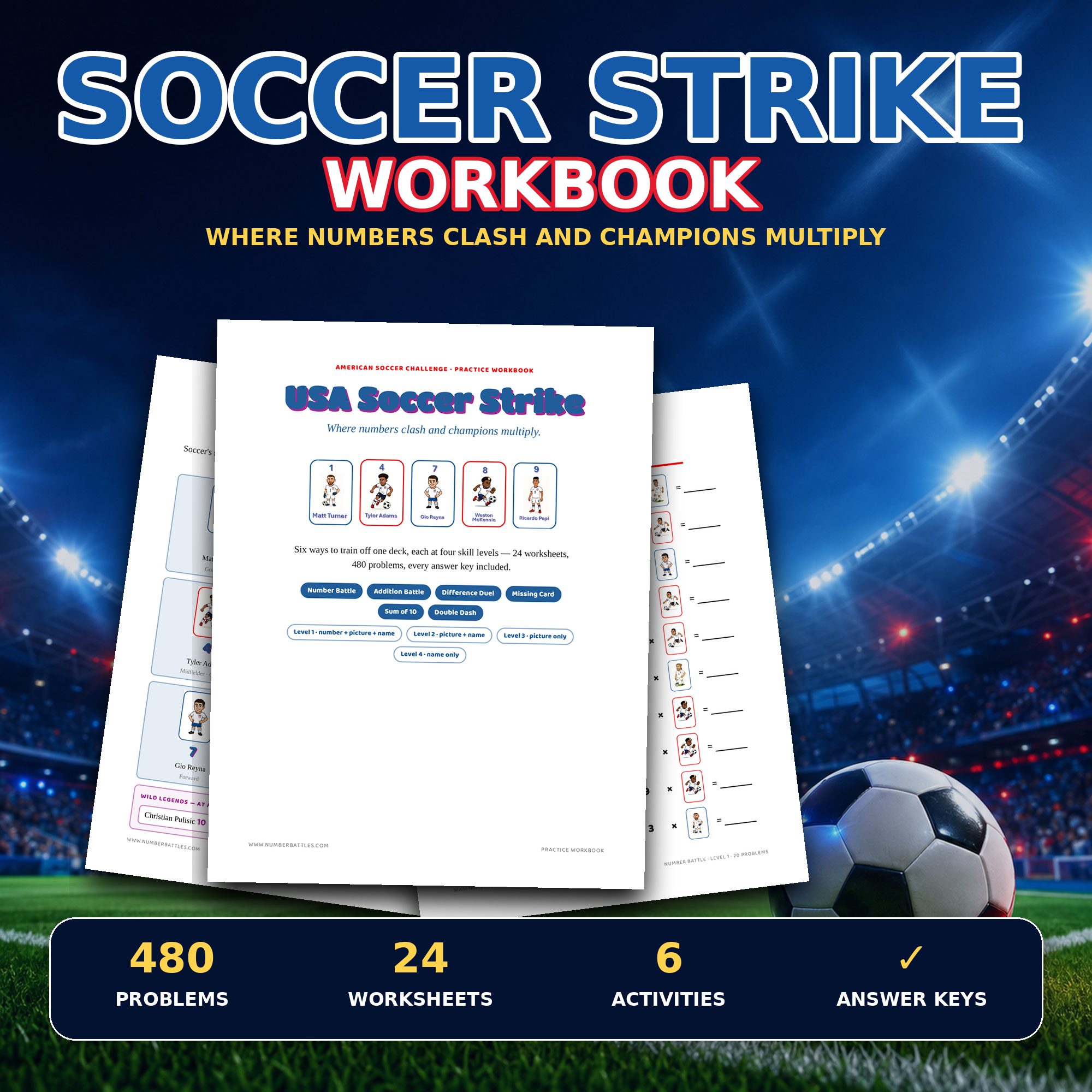
Soccer Strike Workbook
Soccer Strike Workbook | Soccer-Themed Addition, Subtraction & Multiplication Math Practice
Turn math practice into match day! The Soccer Strike Workbook combines the energy of soccer with 480 carefully sequenced problems that build addition, subtraction, multiplication, missing-number skills, sums to 10, and doubles. With six practice formats, four scaffolded levels, a complete study key, answer keys, and a Champion's Certificate, this printable workbook makes differentiation easy and practice exciting.
Bring the excitement of the soccer field into math time with the Soccer Strike Workbook - a 58-page printable resource designed to make essential number skills feel like a championship challenge.
Students first learn the number connected to each soccer player card. Then they use those visual clues to solve problems across six engaging activities. The challenge grows gradually through four levels: students begin with the number, picture, and name together; then the supports fade until they can solve from the player's name alone. That built-in progression gives teachers an easy way to differentiate while helping students strengthen recall, confidence, and fluency.
Inside, students tackle 480 total problems across 24 worksheets:
Number Battle - multiplication practice
Addition Battle - add two player-card values
Difference Duel - subtraction practice
Missing Card - solve for the unknown number
Sum of 10 - build fluency with number pairs that make 10
Double Dash - strengthen doubles and early multiplication facts
Every activity includes four levels of support:
Level 1: number + picture + name
Level 2: picture + name
Level 3: picture only
Level 4: name only
This flexible format is ideal for whole-group practice, math centers, small groups, independent work, early finishers, homework, intervention, review, or enrichment. Soccer fans get a theme they love, while teachers get meaningful practice that can grow with each learner.
What's Included
58-page printable PDF workbook
24 student worksheets
480 total math problems
6 different practice formats
4 scaffolded skill levels for every format
Soccer Strike Study Key
Complete answer keys
Champion's Certificate
Skills Practiced
Addition fluency
Subtraction fluency
Multiplication facts
Missing-number equations
Number pairs that make 10
Doubles facts
Visual memory and number association
Independent problem solving
Perfect For
Math centers and stations
Independent practice
Small-group instruction
Intervention and review
Early finishers
Homework
Sub plans
Soccer-themed classroom activities
Suggested Call to Action
Kick off stronger math fluency today. Download the Soccer Strike Workbook and let your students practice, progress, and play their way toward mastery!
Make math practice exciting with the Soccer Strike Workbook: 480 soccer-themed addition, subtraction, multiplication, missing-number, sums-to-10, and doubles problems across four differentiated levels. Includes 24 worksheets, study key, answer keys, and certificate.
Important Product Note
This is a digital, printable PDF resource. No physical product is included. Number Battles is an independent educational platform and is not affiliated with, associated with, authorized by, or endorsed by U.S. Soccer, FIFA, or their subsidiaries.
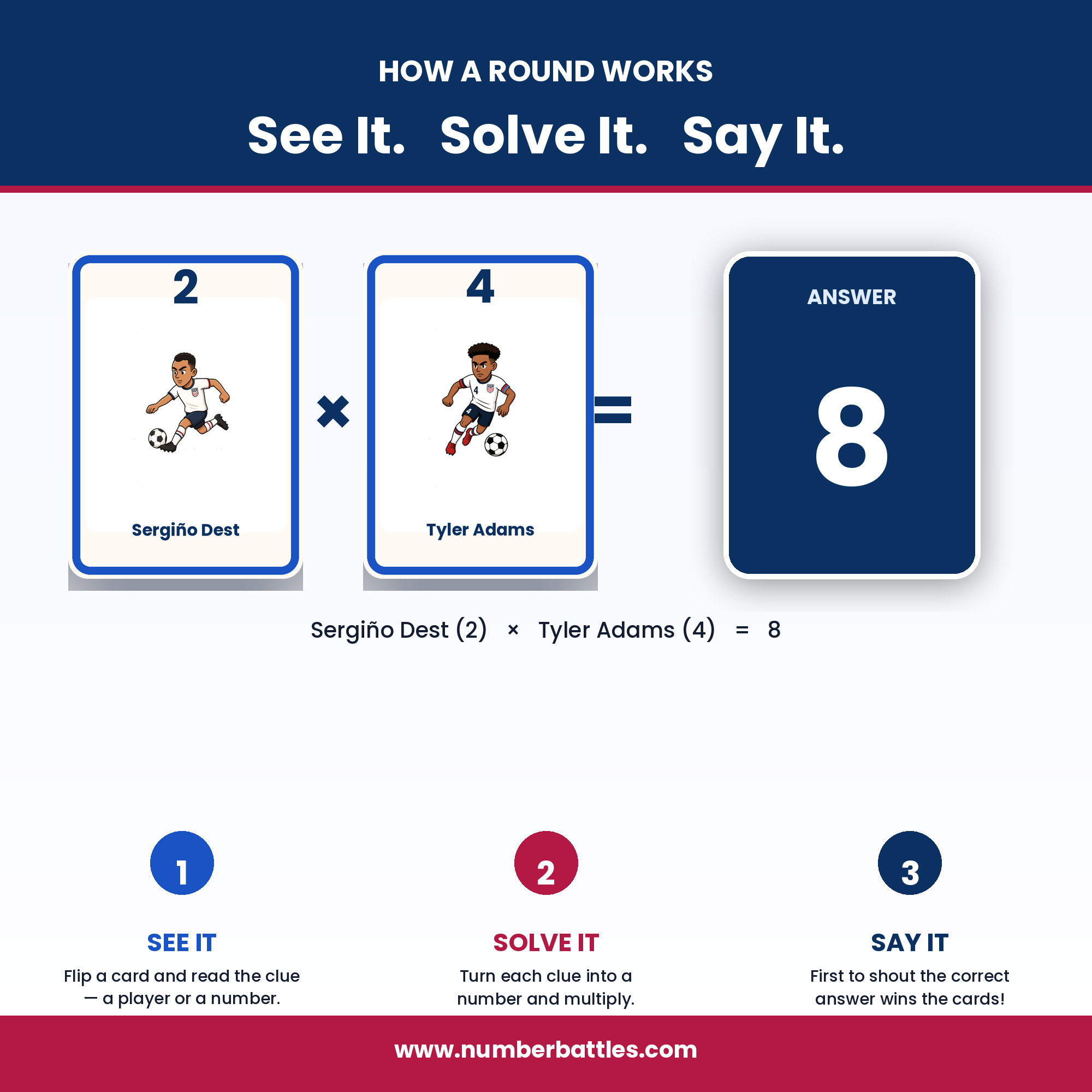
Turn the U.S. Men's National Team into a fast, friendly math duel.
A print-and-play flash-card game plus a 150-problem workbook that builds multiplication fluency and lightning recall. 13 cards, 4 skill levels, answer keys, and a certificate. Ages 7+ · Grades 3–9.
Where numbers clash and champions multiply.
USA Soccer Strike takes the classic card game of War and gives it meaning. Instead of a plain number, every card is a USMNT player: Matt Turner is 1, Yunus Musah is 6, Ricardo Pepi is 9. Players decode the clue into a number, multiply against their opponent, and race to shout the answer. First to call the correct product wins the round.
It's the kind of game that doesn't feel like practice. Kids build number sense, memory, and multiplication recall while playing a soccer showdown with players they actually know — and four Wild "legend" cards (Dempsey, Bradley, Pulisic, and Donovan) that ADD to your opponent's card before you multiply, turning any round on its head.
The genius is the four-level design. The same thirteen cards print in four decks, each revealing a little less. Beginners start on Level 1 with the number, picture, and name all showing. As recall improves, players climb — until Level 4, where only the name remains and it's pure memory. Mix decks together and everyone from a struggling learner to a multiplication master stays in the same game.
When the cards are put away, the built-in workbook keeps the practice going: six worksheets and 150 problems that scale right alongside the decks, from straightforward multiplication matches up to the full Wild-card mix. Every worksheet has a complete answer key, so it's ready for the classroom, homeschool, tutoring, or the kitchen table with zero prep. Finish the challenge and print the Certificate of Completion to celebrate a true Number Battle champion.
Just print, cut, and play.
What's Included
How to Play — full rules, the four skill levels, and bonus variations
Visual Study Key — all 13 cards and the number each one stands for
Four Printable Decks — one per level, colour-coded so they never get mixed up (13 cards each: 9 players + 4 Wilds)
Practice Workbook — six worksheets, 150 problems: Multiplication Match, Association Mix-Up, Wild Card Combo, Brain Buster Challenge, plus Double Dash and Sums of 10 drills
Answer Keys — full solutions for every worksheet
Certificate of Completion — celebrate a finished challenge
Instant digital download · print-and-play · US Letter, print-at-home friendly

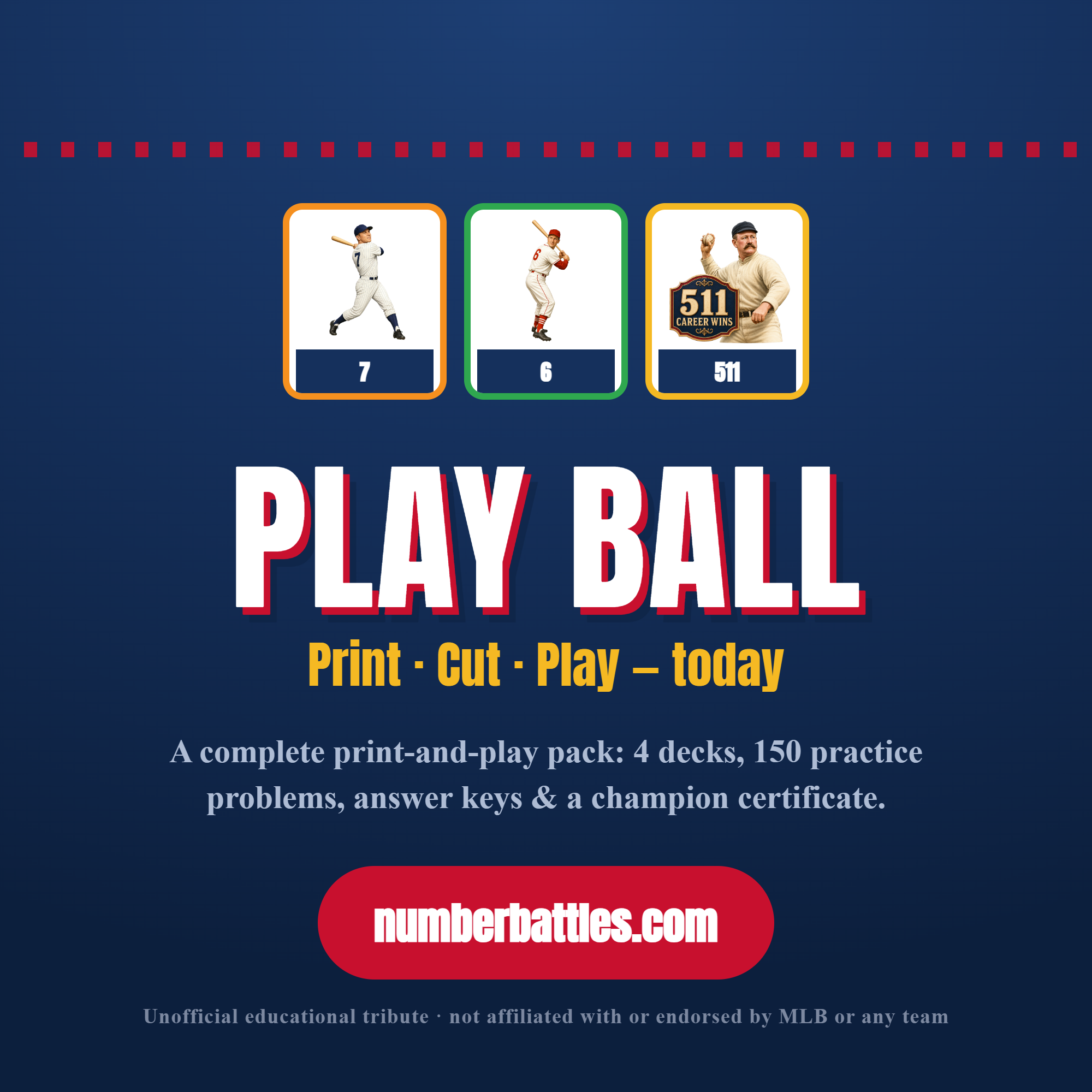
Baseball Barrage: A Baseball-Themed Multiplication Card Game
Step up to the plate and turn multiplication practice into a fast-paced baseball battle!
Baseball Barrage is a printable math card game that combines multiplication fluency, number sense, baseball knowledge, and visual memory. Each card represents a hidden number connected to a baseball play, fielding position, famous jersey number, or legendary milestone. Students decode the baseball clue, multiply the values, and race to call out the correct product.
A Single represents 1, a Catcher represents 2, a Full Count represents 5, Mickey Mantle represents 7, and Nine Innings represents 9. As students play, they begin recognizing the numbers automatically—making repeated multiplication practice feel more like a game than an assignment.
Four Levels of Play
Baseball Barrage grows with your students through four progressively challenging decks:
Rookie: Number, picture, and name are shown.
Challenger: Picture and name are shown, but players recall the number.
Champion: Picture-only cards provide a greater memory challenge.
All-Star: Name-only clues and powerful Wild Cards create expert-level play.
Students can play the traditional Number Battle, where the first player to multiply the two decoded numbers wins the cards, or use the Sum of 10 Showdown variation to strengthen addition and number sense.
Baseball Wild Cards
Four exciting Wild Cards introduce memorable baseball facts and larger-number challenges:
Green Monster height — 37
Joe DiMaggio’s hitting streak — 56
Distance between bases — 90 feet
Cy Young’s career wins — 511
What Is Included
This 32-page printable resource includes:
Complete instructions for two ways to play
Baseball Decoder Keys
Four differentiated printable card decks
18 baseball number concepts covering values 1–9
Four baseball Wild Cards
Explanations showing how every baseball clue connects to its number
Six multiplication practice worksheets
150 total practice problems
Complete answer keys
Baseball Barrage Champion certificate
The resource is designed for ages 7 and up and works especially well for students in grades 3–9.